Glossary of terms
Below is some technical terminology that can be used for reference and understanding.
Condensing boiler
Although the installation of condensing boilers has been mandatory since 2005 most boilers do not operate in condensing mode without specific conditions being met. If you can drop the boiler supply temperature to 55 deg C (You might need to measure it) and still provide adequate hot water performance you will likely have your boiler condensing more frequently saving money. If you find that hot water is not adequate or house heating is not adequate adjust temperature up 5 degrees at a time to achieve the lowest supply temperature that will promote boiler condensing.
Buffer
A storage vessel installed between the heat source and the distributed heating system to provide water volume and also hydraulic isolation but can and will reduce system efficiency overall
DT (Delta T)
This is in reference in temperature between two points in a system. It could be flow and return in a boiler or heat pump or could be a difference between inside and outside air temperature and is measured in Deg C or Kelvin.
FIT
Feed in Tariff. This is an electric tariff that was created by the government to encourage uptake of solar PV panels.
Modulating boiler
Although modulating boilers have been available for many years they are not always installed by default, but having a modulating boiler allows the opportunity for weather compensation to be enabled saving energy and increasing overall system efficiency.
Legionella cycle
Legionella disease is a lung infection that you can get from inhailing droplets of water containing the bacteria. The bacteria can survive and multiply in water between 20 and 45 degrees. The bacteria does not survive in temperatures above 60 deg C. A regular Legionella cycle which takes the water temperature in a hot water cylinder above 60 degrees will prevent the risk of Legionella.
Low Loss Header
Provides hydraulic separation between one or many circuits in a water system
MWT
Mean water temperature. This is the average temperature between the flow and return temperature in a water system.
MWT-AT
Mean water temperature to room air temperature is used by designers when selecting correct radiators or underfloor heating systems and is the difference between the room temperature and the average of flow and return into the heat emitter such as a radiator.
Room temperature controller
A room temperature controller in its simplest form can just switch on and off the heat source. More complex controllers can provide different temperature setpoints at different times but for optimal control the room temperature controller should provide a modulating signal to the heat source.
Volumiser
A volumiser is a vessel that is added into a water system to increase the volume primarily to reduce cycling and in a heat pump system provide enough system volume to carry out a defrost cycle.

Weather compensation
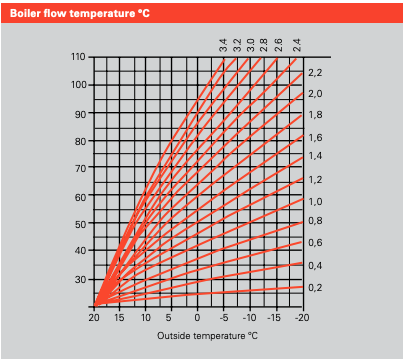
There are a few different variants of weather compensation and in its simplest form the flow temperature of the heat source will adjust dependant on what the outside air temperature is. The reason for this is that as the difference between the inside temperature and the outside temperature increase more energy is required to be injected into the house to make up for that greater loss. Subsequently it makes no sense for the heat source to run at a constant temperature and this is the principal of weather compensation. Basic weather compensation will provide one curve others will provide many curves that can be selected to match the building fabric losses. Some manufacturers also provide load compensation where it can take into consideration the required room setpoint and adjust the curve to compensate and deliver the correct amount of energy. fine tuning of weather compensation can take some time to get the system optimized. Weather compensation is only available on a heat source that can modulate its output.
